
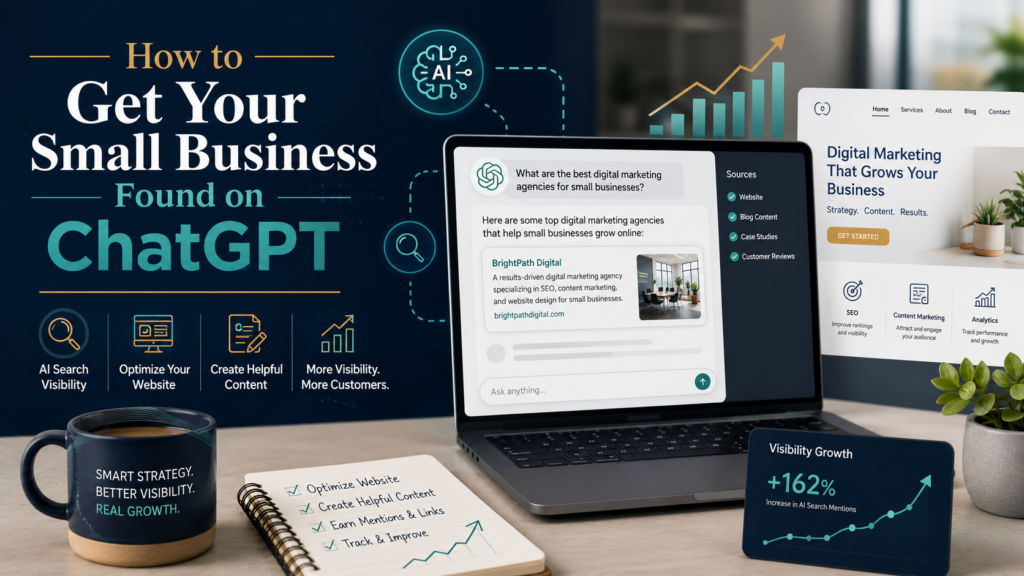
Want to know how to get your small business found on ChatGPT and Google AI Search? This guide explains the practical website, SEO and content improvements that can increase your visibility.
People no longer rely only on traditional searches such as “website designer near me,” “SEO writer for small business,” or “company that creates SOPs.” Many customers now ask complete questions through ChatGPT, Google AI Mode and Google AI Overviews.
They may ask:
- Who can build an affordable website for my small business?
- Which company can create professional standard operating procedures?
- Where can I find an SEO content writer for a growing business?
- Who can create an Excel dashboard for my company?
- Which digital agency supports small businesses in the United States, Canada or the United Kingdom?
AI-powered search tools may respond with explanations, recommendations and links to relevant websites. This creates a valuable opportunity for small businesses that establish a clear, useful and trustworthy online presence.
There is no guaranteed method for forcing ChatGPT or Google to recommend a particular company. However, businesses can take practical steps to make their websites easier for search platforms to find, understand and potentially reference.
This guide explains how to improve your small business’s visibility in ChatGPT, Google AI Mode, Google AI Overviews and traditional Google search results.
Table of Contents
What Is AI Search Visibility?
AI search visibility describes how easily an AI-powered search platform can find, understand and potentially reference information about your business.
Traditional search engines usually provide a list of webpages. AI search tools can review information from multiple sources and combine it into a conversational response.
For example, a potential customer may no longer search only for:
“Small business website designer”
Instead, they may ask:
“What should I look for when hiring someone to build a professional five-page website for my service business?”
The AI platform may then provide an explanation, compare possible options and link to websites it considers relevant.
According to Google’s official guidance for AI features, websites do not need a completely separate optimization system to appear in AI Overviews or AI Mode. The same foundational SEO practices used for traditional Google Search remain important.
This means traditional search engine optimization is not disappearing. Small businesses must strengthen the foundations they already need while making their information clearer for conversational search.
How to Get Your Small Business Found on ChatGPT
There is no universal submission form that guarantees your company will appear whenever someone asks ChatGPT for a business recommendation.
Using ChatGPT or creating an OpenAI account does not automatically add your business to ChatGPT search results.
ChatGPT Search can use publicly available information from the internet and may provide links to relevant sources. OpenAI uses a crawler called OAI-SearchBot to help discover website content that may be shown in ChatGPT’s search features.
OpenAI explains that websites blocking OAI-SearchBot will not be shown as sources in ChatGPT search answers, although they may still appear as basic navigational links. Website owners can review the official OpenAI crawler documentation for more information.
Allowing the crawler does not guarantee that ChatGPT will recommend your business. Your company still needs clear, accessible, relevant and trustworthy information online.
Make Sure Your Website Can Be Crawled and Indexed
Before a search platform can understand your website, it must be able to access it.
A website may look perfectly normal to visitors while still containing settings that prevent search engines from crawling or indexing important pages.
Check that:
- Your website is not set to discourage search engines.
- Important pages are not blocked by your robots.txt file.
- Your pages do not contain an accidental noindex instruction.
- Your XML sitemap is active and working.
- Your website has been verified in Google Search Console.
- Your most important pages are included in the website navigation.
- Your content can be viewed without requiring visitors to sign in.
- Your website works correctly on mobile devices.
- Your hosting or security system is not blocking legitimate search crawlers.
- OAI-SearchBot is not being blocked from public content you want ChatGPT Search to discover.
Google explains that its search systems generally discover pages automatically through web crawlers. However, Google does not guarantee that every webpage will be crawled, indexed or displayed in search results. You can learn more through Google’s guide explaining how Google Search works.
Do not replace your robots.txt file with instructions copied from an unknown website. An incorrect robots file can prevent Google, ChatGPT and other search platforms from accessing important content.
Google Search Console can help you check whether your pages have been discovered and indexed. It may also identify technical problems that prevent your website from appearing properly in search results.
Create a Separate Page for Every Important Service
One of the most common small-business website mistakes is placing every service into one short paragraph.
Imagine that a company offers:
- Small-business website design
- SEO content writing
- Technical writing
- Standard operating procedure development
- Excel dashboards
- Business reporting
- Digital business support
When all these services are combined on one general page, search platforms may have difficulty determining which services the company specializes in.
Each important service should have its own dedicated page.
A website-design service page should explain:
- The type of websites the company builds
- Who the service is designed for
- What the package includes
- Which website platform is used
- Whether mobile optimization is included
- Whether basic SEO setup is included
- How long the project may take
- How customers can request a consultation
An SEO content-writing page should explain:
- Keyword research
- Blog writing
- Website copy
- Service-page writing
- Product descriptions
- Internal linking
- Search-friendly headings
- Content updates
A technical-writing page should clearly describe:
- Standard operating procedures
- Work instructions
- Business processes
- Manuals
- Checklists
- Training guides
- Technical reports
Dedicated pages help potential customers find relevant information quickly. They also provide search platforms with clearer and more focused sources to evaluate.
ValenCore Digital uses this structure through its main digital services page, small-business website-design service and SEO content-writing service.
Answer the Questions Your Customers Actually Ask
AI search is conversational.
People often ask detailed questions instead of entering one or two keywords. Your website should therefore answer realistic questions that potential customers may ask.
A website-design company could answer questions such as:
- How much does a small-business website cost?
- How many pages should a business website have?
- Is WordPress suitable for a small company?
- How long does it take to build a website?
- What should be included in a website-design package?
- Does a new website include basic SEO?
- How much does website maintenance cost?
- Can an existing website be redesigned?
- Who will update the website after launch?
A technical-writing company could answer questions such as:
- What is a standard operating procedure?
- Why does a small business need SOPs?
- How much does professional SOP writing cost?
- What should an SOP include?
- Can ChatGPT help create business procedures?
- What is the difference between a policy, procedure and work instruction?
Do not publish dozens of weak pages that repeat the same answer using slightly different keywords.
Focus on creating useful content that clearly answers the question, explains the subject and gives readers a practical next step.
For example, business owners researching website pricing can review this detailed guide explaining how much a small-business website costs in 2026.
Clearly Explain What Your Business Does
Your website should make your business identity easy to understand.
Visitors should not need to search through several pages before discovering what your company provides.
Include clear information such as:
- Your full business name
- A straightforward explanation of your services
- The types of customers you support
- The industries you understand
- The countries or regions you serve
- Your contact information
- A professional About page
- Your relevant experience
- A business email address
- Consistent branding
- Links to legitimate professional profiles
Avoid vague statements such as:
“We deliver innovative solutions that transform the future.”
Although this may sound professional, it does not clearly tell potential customers what the company offers.
A more useful description would be:
“We provide small-business website design, SEO content writing, technical documentation and Excel reporting support for companies in the United States, Canada and the United Kingdom.”
Clear business descriptions help both human visitors and search platforms understand your company.
Strengthen Your About Page
AI search visibility is not only about keywords.
Customers and search platforms also need reasons to trust the company behind the content.
Your About page should explain:
- Who operates the business
- The professional experience behind the company
- Why the company was established
- The problems the business solves
- The standards used to complete work
- The types of customers supported
- The values that guide the company
Avoid unsupported claims such as:
“We are the number-one digital agency.”
“The world’s leading provider.”
“The best company in the industry.”
These statements can weaken trust when they are not supported by evidence.
Use specific and believable information instead.
For example:
“Our approach combines engineering-level attention to detail with practical digital support for small businesses.”
This type of statement gives the business a clearer identity and helps differentiate it from generic competitors.
A well-developed About page should support the information presented on your homepage and service pages.
Publish Original and Experience-Based Content
AI platforms can summarize common information quickly. A basic article that repeats advice already found on hundreds of websites may struggle to stand out.
Your content should add something genuinely useful.
Examples include:
- A practical checklist
- A detailed project process
- A pricing comparison
- Lessons learned from completed work
- Common customer mistakes
- Before-and-after examples
- Original templates
- Industry-specific guidance
- Professional opinions based on experience
- Clear explanations of how you solve a particular problem
Small businesses may not publish as much content as large companies, but they can often provide more specific and practical information.
Quality is more valuable than simply producing a large number of articles.
Google states that generative AI can help with research and content organization. However, publishing large quantities of AI-generated pages without adding useful value may violate Google’s policies on scaled content abuse. Review Google’s guidance on responsible use of generative AI content before using automation to create website pages.
Each article should have a clear purpose. It should answer an important question, support one of your services and help the reader make a better decision.
Organize Every Page Clearly
A well-organized page is easier for visitors to read and easier for search platforms to interpret.
Use:
- One clear page title
- Descriptive section headings
- Short paragraphs
- Helpful bullet points
- Relevant images
- Descriptive image alternative text
- Internal links
- A visible call to action
Avoid extremely large blocks of uninterrupted text.
The opening paragraph should quickly explain what the page covers. Each section heading should accurately describe the information below it.
Do not create headings only to repeat keywords. Use them to guide the reader logically through the page.
There is no universal article length that guarantees visibility. The content should be long enough to answer the reader’s question properly without adding unnecessary repetition.
Use Strong Internal Links
Internal links connect related pages within your website.
For example, an article about AI search visibility could link to:
- Your SEO Content Writing service
- Your Small Business Website Design service
- Your main Services page
- A related website-cost article
- Your Contact page
Internal links help visitors continue their research. They also help search engines discover important pages and understand how different sections of your website are connected.
Use meaningful link wording.
Instead of writing:
“Click here”
Write:
“Learn more about our small-business SEO content-writing service.”
The linked wording should tell visitors where the link will take them.
You can also direct readers to your small-business website-design service when discussing website improvements.
Keep Your Business Information Consistent
Your business name, website address, contact details and service descriptions should be consistent across the internet.
Review your:
- Website
- Google Business Profile, where appropriate
- LinkedIn company page
- Professional directories
- Social-media profiles
- Industry listings
- Partner websites
- Author biographies
Inconsistent information can confuse potential customers and search platforms.
For example, one profile may describe your company as a website-design business, while another describes it only as a virtual-assistant service.
Update old profiles so they accurately reflect your company’s current services and positioning.
Your company name should also be written consistently. Avoid using several different versions of the business name unless there is a genuine legal or branding reason.
Add Appropriate Structured Data
Structured data is code that helps search engines interpret information about a webpage, article, product or organization.
Relevant structured-data types may include:
- Organization
- LocalBusiness
- Article
- Service
- Breadcrumb
- Product, where applicable
Google explains that Organization structured data can provide administrative information such as a company’s name, logo, address, website and contact details. Read Google’s official guide to Organization structured data before adding or changing this information.
However, structured data does not guarantee higher rankings or inclusion in AI-generated answers.
Google also states that businesses do not need special AI structured data or a unique AI schema to appear in AI Overviews or AI Mode. Structured data should remain part of a broader SEO strategy rather than being treated as a guaranteed shortcut.
The information contained in structured data must match what visitors can see on the page.
Do not add:
- Fake reviews
- False ratings
- Incorrect business locations
- Services the company does not provide
- Awards the company has not received
- Misleading pricing information
Many WordPress SEO plugins can help manage basic structured data without requiring the business owner to write the code manually.
Build Legitimate Mentions Beyond Your Website
Your own website is not the only place where information about your business may appear.
Independent information can come from:
- Customer reviews
- Professional directories
- Industry publications
- Interviews
- Local business organizations
- Partner websites
- Relevant social profiles
- Genuine media coverage
- Professional associations
Focus on earning legitimate mentions by completing valuable work and building real professional relationships.
Avoid purchasing fake reviews, spam links or hundreds of low-quality directory listings.
These tactics can damage your business’s credibility instead of improving it.
A few genuine reviews and reputable mentions are more valuable than a large number of artificial ones.
Google’s guidance for generative AI search specifically warns businesses against chasing inauthentic mentions as a shortcut. Its ranking and spam-detection systems continue to focus on content quality and genuine value.
Keep Important Content Updated
Outdated information can reduce customer confidence and weaken your online visibility.
Review your website regularly to confirm that:
- Services are still available
- Contact details are correct
- Prices or estimated price ranges are current
- Team information is accurate
- Broken links are repaired
- Old statistics are updated
- Previous years are changed where necessary
- Screenshots match the current software
- Forms and buttons still work
- Calls to action lead to the correct page
Do not change an article’s publication date without making meaningful improvements.
An article labelled as current should contain current information.
When updating an article, review the entire page rather than changing only the year in the title.
Improve Website Speed and Mobile Usability
A website that is slow or difficult to use can lose potential customers before they read the content.
Many people search for services using mobile devices. Your website should therefore be easy to navigate on smaller screens.
Check that:
- Text is large enough to read
- Buttons are easy to select
- Menus work correctly
- Images do not extend beyond the screen
- Forms can be completed on mobile devices
- Pop-ups do not cover the entire page
- Pages load within a reasonable time
- Important information appears near the top
- Contact options are easy to find
Large images, unnecessary plugins, poorly configured themes and excessive animations can slow down a WordPress website.
Improving speed and mobile usability supports both the customer experience and overall search performance.
Track Your Search Performance
Use data instead of guessing whether your strategy is working.
Google Search Console can help you monitor:
- Search impressions
- Clicks
- Search queries
- Page indexing
- Countries
- Devices
- Technical issues
- Individual page performance
Monitor which pages receive impressions and visits. When one subject begins performing well, create additional supporting content without publishing another article that targets exactly the same keyword.
A supporting article should answer a related question and link back to the main page.
For example, a broad website-design page could be supported by articles about:
- Website pricing
- WordPress versus website builders
- Website maintenance
- Mobile design
- Search indexing
- Pages every small-business website needs
Test How Clearly AI Platforms Understand Your Business
You can perform simple tests by asking conversational questions related to your company.
Examples include:
- What services does this business provide?
- Who does this company serve?
- Does this company provide website design?
- Does this company create SOPs?
- Does this company write SEO articles?
- What countries does this business serve?
- How can someone contact this company?
AI responses can vary, and a missing result does not automatically mean something is technically wrong.
Use these tests to identify possible clarity problems.
When an AI tool cannot easily determine what your company does, a potential customer may also struggle to understand it.
Review the wording on your:
- Homepage
- About page
- Services page
- Individual service pages
- Contact page
- Professional profiles
Common AI Search Optimization Myths
Traditional SEO Is Dead
Traditional SEO remains important.
Google’s generative AI search features are connected to its existing ranking, indexing and quality systems. Crawlability, indexing, useful content, internal links and a good page experience still matter.
An llms.txt File Guarantees AI Visibility
No special file can guarantee that Google AI Mode or AI Overviews will feature your website.
Google states that an llms.txt file is not required for its generative search features and that Google Search does not use it as a special ranking or visibility signal.
Website owners should follow the official crawler guidance provided by each individual platform instead of relying on one supposed universal AI trick.
Structured Data Guarantees an AI Recommendation
Structured data can help search engines understand your content, but it does not guarantee inclusion in an AI-generated response.
Your visible content, technical setup, relevance, credibility and overall quality still matter.
Publishing Hundreds of AI Articles Will Make a Website Rank
Publishing more pages does not automatically make a website more trustworthy.
Low-quality or repetitive content may compete with your existing pages, confuse search engines and make the website less useful.
Focus on fewer, stronger articles that answer meaningful customer questions and connect naturally to your services.
An Agency Can Guarantee ChatGPT Placement
No legitimate agency can guarantee that ChatGPT, Google AI Mode or Google AI Overviews will recommend a particular business.
Search and AI platforms control their own results. Those results may change depending on:
- The question being asked
- The user’s location
- The available sources
- The platform being used
- The freshness of the information
- The relevance of the business
- The quality of the website
A professional service can improve your website’s technical condition, content quality and discoverability. It cannot control every AI-generated response.
AI Search Visibility Checklist for Small Businesses
Use this checklist when reviewing your website:
- Confirm that the website is accessible to search crawlers.
- Verify the site in Google Search Console.
- Submit and test the XML sitemap.
- Check that important pages are indexed.
- Review whether OAI-SearchBot is being blocked.
- Create a separate page for each major service.
- Strengthen the homepage description.
- Complete the About page.
- Add clear contact information.
- Publish useful and original articles.
- Add internal links between related pages.
- Keep business details consistent.
- Update relevant professional profiles.
- Add appropriate structured data.
- Improve mobile usability.
- Improve page speed.
- Monitor search and referral traffic.
- Update outdated pages regularly.
- Avoid fake reviews and spam links.
- Avoid unsupported claims.
- Use clear calls to action.
Frequently Asked Questions
How do I get my business to appear in ChatGPT?
Create a clear, trustworthy and publicly accessible website. Ensure that OAI-SearchBot is not blocked, publish useful content, create dedicated service pages and maintain consistent business information across legitimate online sources.
These steps can improve discoverability, but inclusion is not guaranteed.
Can I submit my website directly to ChatGPT?
There is no general submission form that guarantees placement in ChatGPT search answers.
OpenAI recommends allowing OAI-SearchBot to access the public website content you want to be eligible for ChatGPT search discovery. Review the official OpenAI crawler instructions before changing your robots.txt file.
How do I appear in Google AI Overviews?
A page generally needs to be indexed and eligible to appear in Google Search before it can be considered for Google’s AI-powered search experiences.
Google says there are no separate technical requirements, special AI files or unique schema types required for AI Overviews and AI Mode. Review Google’s guide to AI features and your website for the current requirements.
What is the difference between SEO, AEO and GEO?
SEO means search engine optimization.
AEO commonly means answer engine optimization.
GEO commonly means generative engine optimization.
AEO and GEO describe attempts to improve visibility in AI-generated answers. From Google’s perspective, optimizing for generative AI search remains part of search engine optimization rather than a completely separate process.
Does schema markup guarantee AI visibility?
No.
Structured data can help search engines understand your content and may support certain enhanced search-result features, but it does not guarantee rankings, citations or recommendations.
How long does AI search optimization take?
There is no standard timeline.
Results depend on factors such as:
- The age of the website
- Its technical condition
- Competition
- Content quality
- Website authority
- Internal linking
- How quickly platforms crawl changes
- Whether the information matches the user’s question
Can a new website appear in AI search results?
Yes, a new website may become eligible after it becomes accessible, crawlable, indexed and relevant.
However, Google, ChatGPT and other platforms do not guarantee that a particular page will be crawled, indexed or selected for an AI-generated answer.
Should small businesses stop focusing on regular Google Search?
No.
Traditional Google Search, Google AI Overviews and Google AI Mode remain closely connected. Improving technical SEO, content quality, internal linking and website usability can support visibility across several search experiences.
Final Thoughts
AI-powered search is changing how customers discover and compare businesses, but the foundations of online visibility have not disappeared.
Small businesses still need:
- A technically accessible website
- Clear service pages
- Helpful content
- Consistent business information
- Strong internal links
- Professional credibility
- Regular updates
- A good customer experience
The goal should not be to manipulate ChatGPT or Google with temporary tricks.
The goal should be to create the clearest, most useful and most trustworthy online representation of your business.
When your website explains exactly who you help, what you provide and why customers should trust you, both human visitors and search platforms have a better opportunity to understand your company.
Improve Your Business’s Online Visibility
Is your small business difficult to find online?
ValenCore Digital helps small businesses improve their websites, service pages, SEO content and digital visibility across the United States, Canada and the United Kingdom.
Whether you need a professional small-business website, clearer SEO-focused website content or practical digital business support, ValenCore Digital can help you build a stronger online foundation.
Contact ValenCore Digital today to request a free consultation.